
AUGUST 21, 2026
What Is Bilona Ghee? Traditional Process Explained
What Is Bilona Ghee? The Taste of Home After 9 Years
Have you ever been away from home for a long time and suddenly craved something as simple as ghar ka khana?
Not restaurant food. Not something fancy.
Just that one familiar taste that instantly makes you think, haan, this is home.
For me, it was ghee.
I spent nine years away from home. Nine years of new places, new people, new routines and, of course, new food.
I got used to all of it. But every once in a while, I would miss the food I grew up eating. The food that didn't need a recipe card or a fancy ingredient. The food that somehow tasted better because it was made at home.
And then I came back. I remember having ghee again and thinking, “Yaar, woh ghar wale ghee jaisa taste Kahan hai?”
That question stayed with me. Because I wasn't really looking for just another jar of ghee. I was looking for that taste of home.
And the more I looked into it, the more I realised that maybe the difference wasn't just in the milk or the butter. It was in the way the ghee was made.
Milk was turned into curd.
Curd was churned.
Makhan was separated.
And that Makhan was slowly cooked into ghee.
A long process. An old process. A process I had almost forgotten existed.
Bilona.
And somewhere between missing home and rediscovering that process, the idea for Aavya began.
So, what exactly is Bilona ghee?
Simply put, it is ghee made using a traditional, curd-based process. Fresh cow milk is first turned into curd, the curd is churned to separate Makhan (butter), and the Makhan is then slowly cooked to make ghee.
Unlike methods that start directly with cream, traditional Bilona ghee starts with curd.
It takes more time. More patience. More effort.
But that's what makes the process special.
So, when you see Bilona ghee, don't just look at the label. Look at the process behind it.
Because Bilona isn't just a type of ghee. It's a traditional way of making it.
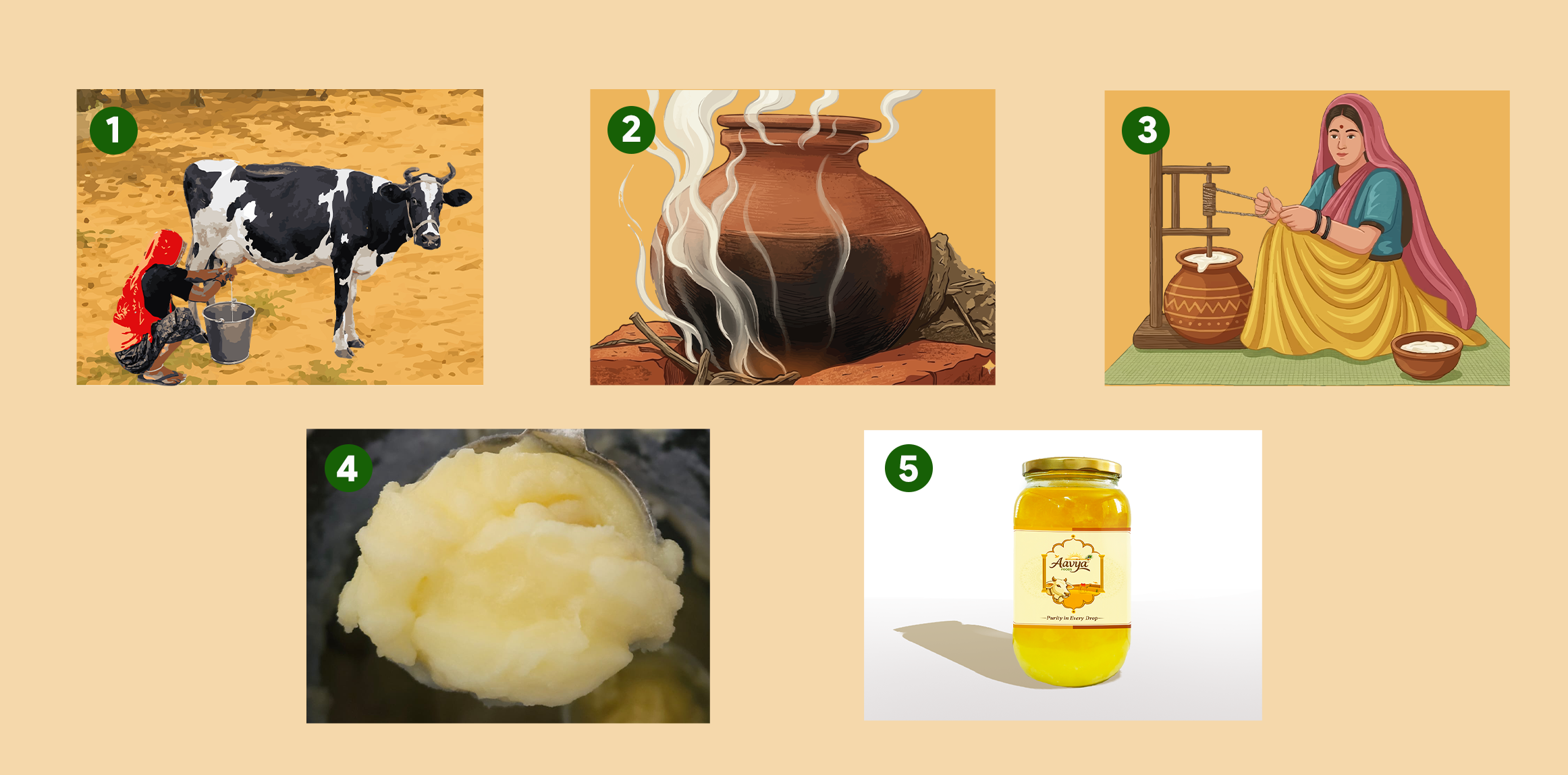
From Milk to Ghee: How the Traditional Bilona Process Works
Making ghee the Bilona way isn't complicated. It just takes time. Here's what happens, step by step:
Milk comes first
Fresh cow milk is boiled and then allowed to cool. But that's only the beginning.Milk turned into curd
The cooled milk is set into curd and left overnight. This is where the traditional Bilona process really starts.Curd is churned
The next morning, the curd is churned to separate the Makhan (butter) from the buttermilk. No rushing this part.Makhan is collected
The freshly churned Makhan is carefully collected. This is what eventually becomes the ghee.Makhan is slowly cooked
The Makhan is heated slowly until the moisture evaporates and the milk solids separate, leaving behind golden ghee.Ghee is strained
Finally, the ghee is strained and that's it. From milk to curd, curd to Makhan, and Makhan to ghee.
It takes time. It takes patience. But that's how something as simple as ghee gets its story.
Bilona Ghee vs. Commercial Ghee: What's Really Different?
Walk into any supermarket, and you'll see rows of ghee jars. Different brands. Different prices. Different claims. Pure. Traditional. Authentic. Homemade.
But how do you know what's actually different?
The easiest place to start is the process.
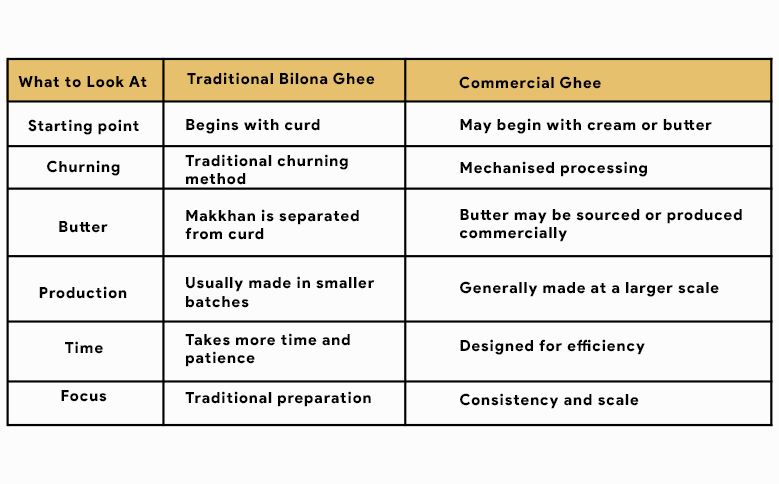
Now, this doesn't mean commercial ghee is bad or that every jar labelled Bilona is automatically authentic.
That's why we believe you shouldn't just look at the word Bilona on the label. Look at what happens behind it.
Does the milk become curd?
Is the curd churned to make Makhan?
Is that Makhan slowly cooked into ghee?
Because at the end of the day, the label tells you what the brand says. The process tells you what you're actually buying.
"Meri Ghee Daani Kyun Hai?" Understanding the Grainy Texture
You open your jar of ghee, take a look at it and notice something unexpected.
It's grainy. Daani-daar.
And the first thought that probably comes to mind is:
“Kahin ghee kharab toh nahi ho gaya?”
Not necessarily. Traditional ghee can naturally develop a grainy texture because of how its fat crystals form, especially with changes in temperature and storage conditions.
So, grainy doesn't automatically mean spoiled.
In fact, that slightly grainy, granular texture is something many people associate with traditionally prepared ghee.
Instead of judging your ghee only by how smooth it looks, pay attention to its smell, taste and overall appearance.
Sometimes, what looks a little different is simply the natural character of the ghee. So the next time you see those tiny grains, don't panic. Your ghee may just be doing what ghee naturally does.

Why I Built Aavya: A Nine-Years Search for Ghar Ka Swaad
For nine years, I lived away from home. And honestly, you get used to it.
You find your routine. You meet new people. You eat whatever is available. You learn to take care of yourself.
Life moves on. But every once in a while, you miss the most ordinary things.
Ghar ka khana. Ghar ki Khushboo. Ghar ka swaad.
For me, I kept missing the food I grew up eating. Nothing fancy. Just simple food made the way it had always been made at home.
When I finally came back, I realised I wasn't only missing the taste. I was missing how that taste was made.
The patience. The slow process. The little things we often take for granted when we're home. And that's where Aavya began. I didn't want to make another ghee and put another jar on a shelf.
I wanted to bring back that feeling I had been missing for nine years. That feeling when you take a bite and, for a second, you're back home.
Maybe you've felt it too?
Because sometimes, you don't realise how much you miss home until something tastes exactly like it.
And for us, Bilona was the way to bring that feeling back.
Explore Aavya Bilona Ghee and bring a little ghar ka swaad to your table.
FAQs
Is Bilona ghee made from curd?
Yes. In the traditional Bilona method, milk is first converted into curd. The curd is then churned to separate Makhan, which is subsequently cooked to make ghee.
What is the difference between Bilona ghee and regular ghee?
The key difference lies in the process. Traditional Bilona ghee starts with curd, which is churned to separate Makhan; then the Makhan is slowly cooked into ghee.
Why does Bilona ghee sometimes have a grainy texture?
Ghee can naturally develop a granular or grainy texture because of fat crystallisation and temperature. Graininess alone does not mean the ghee is spoiled.
Does making Bilona ghee take longer?
Yes. The traditional process involves several stages, including setting the curd overnight, churning the curd, separating the Makhan, and slowly cooking it into ghee.
How should I choose good Bilona ghee?
Look beyond the label. Understand the ingredients, sourcing and process. A trustworthy brand should be able to clearly explain how its ghee is made.