
SEPTEMBER 4, 2026
A2 Bilona Ghee vs Regular Ghee: Key Differences
If you've ever stood in front of a shelf full of ghee wondering “Are these actually different, or am I just paying more for the label?”, you're not alone.
Today, you'll find everything from A2 ghee, Bilona ghee, A2 Bilona ghee, desi ghee, and regular ghee. And with every jar promising something different, figuring out what actually matters can get confusing.
So, let's make it simple.
First, What Do A2 and Bilona Actually Mean?
Think of it this way:
A2 tells you about the milk.
Bilona tells you about the process.
A2 refers to the type of beta-casein associated with the milk used. In contrast, Bilona refers to the traditional method of making ghee, where milk is first turned into curd, the curd is churned to obtain butter, and the butter is then clarified into ghee.
But here's where things get interesting.
Does using A2 milk automatically make the ghee better? Does the traditional Bilona process make a nutritional difference? And why does A2 Bilona ghee usually cost more than regular ghee?
Let's put A2 Bilona ghee vs regular ghee side by side and look at what actually sets them apart, from milk source and preparation to taste, texture, quality, and price.
By the end, you'll know exactly what you're paying for and which type of ghee makes sense for your kitchen.
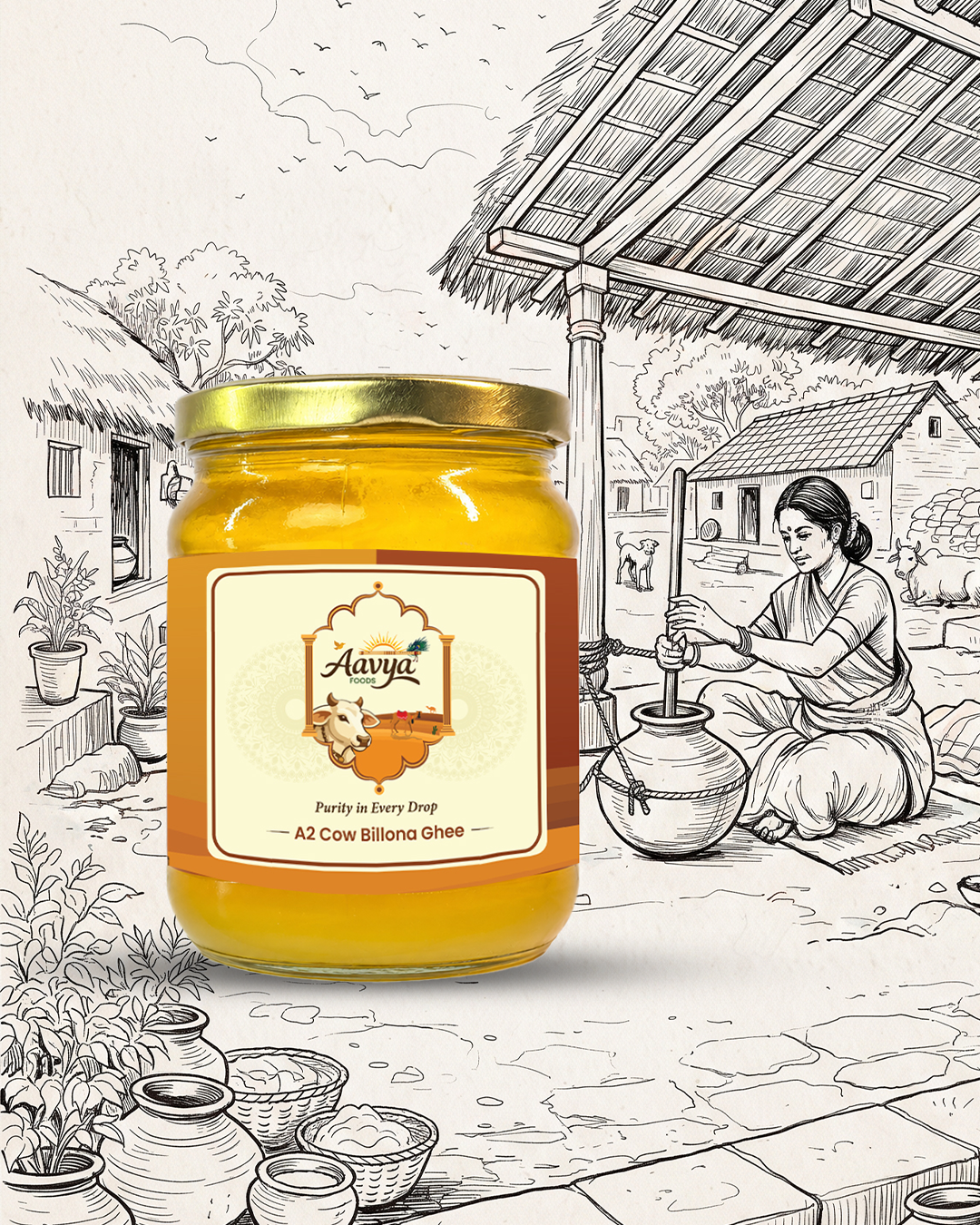
What Is A2 Bilona Ghee?
Let's start with the name itself because A2 Bilona ghee actually combines two different things: the type of milk used and the way the ghee is made.
Think of it this way:
A2 = where the milk comes from
Bilona = how that milk is turned into ghee
Simple, right? Let's break it down.
What Does A2 Mean in Ghee?
A2 refers to a specific variant of beta-casein, a protein naturally found in milk.
Certain cows produce milk containing the A2 form of beta-casein. Many indigenous Indian cattle breeds are associated with A2 milk, although the A2 status of milk is best established through appropriate testing rather than assumed simply based on the breed.
And here's something worth remembering: A2 doesn't automatically mean organic, grass-fed, pure, or traditionally made. These are all different things.
So, when you see claims about A2 ghee benefits, it's important to first understand exactly what the A2 label is telling you.
What Does Bilona Mean?
Now comes the Bilona part.
Bilona isn't a type of cow or milk. It's a traditional way of making ghee.
Instead of separating cream from milk and going straight to butter, the traditional Bilona method takes a more old-school route:
Milk → Curd → Churning → Butter → Ghee
First, the milk is turned into curd. The curd is then churned to separate the butter. That butter is finally heated and clarified to make ghee.
It's this traditional process that gives traditional Bilona ghee its characteristic rich aroma, flavor, and texture.
So, when you see A2 Bilona ghee on a jar, you're essentially looking at A2 milk + the traditional Bilona method.
And that's the real starting point for understanding how it differs from regular ghee.
What Is Regular Ghee?
Now, let's talk about regular ghee. In simple terms, it's clarified butterfat made by separating moisture and milk solids from butter or other dairy ingredients.
The process can vary from brand to brand. Some may use cream, while others may start with butter.
And here's the important part: regular ghee isn't automatically inferior to A2 Bilona ghee.
When comparing A2 ghee vs regular ghee, look beyond the label and consider:
Milk source
Making process
Quality and purity
Food safety and testing
Storage
A good-quality regular ghee can still be a great choice for everyday cooking. The real difference comes down to what goes into it and how it's made.
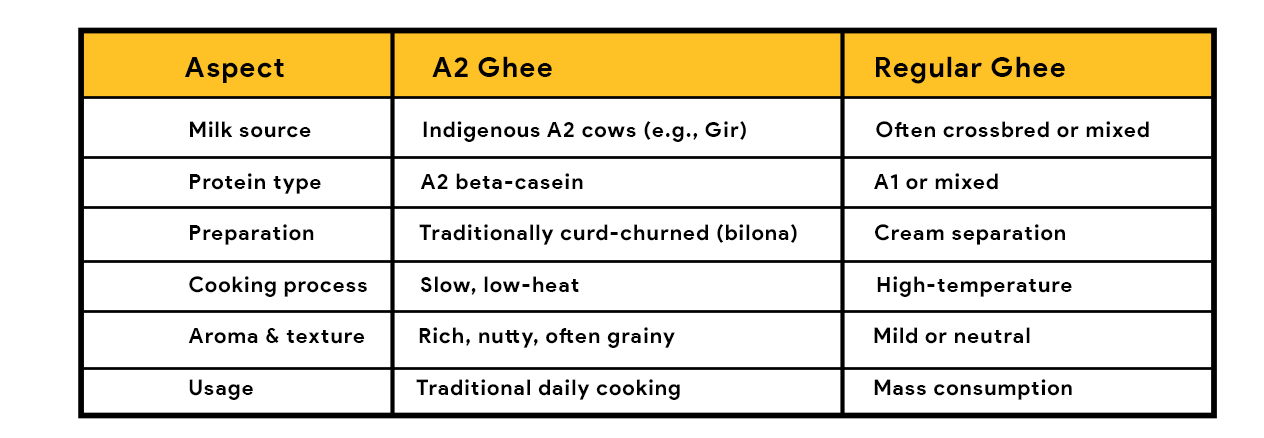
A2 Bilona Ghee vs Regular Ghee: Key Differences
The easiest way to understand the difference between A2 ghee and regular ghee is to compare their key characteristics.
How Is A2 Bilona Ghee Made?
The traditional Bilona ghee-making process involves several stages.
Step 1: Milk Is Collected
Milk is sourced according to the producer's standards.
For products marketed as A2 cow ghee, the A2 claim should ideally be supported by appropriate sourcing information or testing.
Step 2: Milk Is Converted Into Curd
The milk is cultured and allowed to set into curd.
This is an important part of the traditional Bilona method.
Step 3: Curd Is Churned
The curd is churned to separate butter from the liquid portion.
Traditional churning is one of the defining characteristics of the Bilona process.
Step 4: Butter Is Collected
The butter obtained from churning is separated and prepared for clarification.
Step 5: Butter Is Clarified into Ghee
The butter is gently heated so that moisture evaporates and the milk solids separate from the fat.
The clarified fat that remains is ghee.
This traditional process is one of the reasons Bilona ghee is often valued for its rich aroma, distinctive taste, and texture.
A2 Bilona Ghee vs Regular Ghee: Nutritional Differences
Now comes the question most of us really want answered: Does A2 Bilona ghee actually offer more nutrition than regular ghee?
You may have come across several claims about A2 Bilona ghee benefits, but it's important to separate what sounds good on a label from what the product actually contains.
Both A2 Bilona ghee and regular ghee are primarily milk fat, which means both are calorie-dense. The Bilona method doesn't change the basic fact that ghee is a concentrated source of fat, so portion size still matters.
Ghee also naturally contains fat-soluble nutrients such as vitamin A, although the exact nutritional profile can vary depending on the milk source and processing method.
So, it wouldn't be accurate to say that every A2 Bilona ghee automatically contains more nutrients than regular ghee. The actual product and its nutritional testing matter.
But , What About A2 Protein?
This is where there's often some confusion around A2 ghee benefits.
A2 refers to a beta-casein protein found in milk. But ghee isn't milk. During the clarification process, most milk proteins and other non-fat solids are separated, leaving primarily the milk fat behind.
So, while the A2 characteristic comes from the milk used to make the ghee, the finished ghee isn't a significant source of A2 beta-casein protein.
In short: when comparing A2 ghee vs regular ghee, don't assume that the A2 label alone makes one nutritionally superior. The milk source, making process, quality, and actual nutritional composition all matter.
Final Verdict: A2 Bilona Ghee vs Regular Ghee
So, after all that, which one deserves a place in your kitchen?
The answer isn't simply that A2 Bilona ghee is better or regular ghee is better. It really comes down to what you value in your ghee.
A2 tells you about the milk, while Bilona tells you about the traditional process used to make it. Together, A2 Bilona ghee brings a specific milk source and a traditional method of preparation, along with the rich aroma and flavor many people love.
On the other hand, if you're looking for a reliable everyday ghee at an accessible price, a good-quality regular ghee can do the job beautifully.
So, next time you're standing in front of the ghee shelf, don't just ask, “Which one is more expensive?”
Ask yourself:
Where does the milk come from?
How is the ghee made?
Can I trust what's on the label?
Because when it comes to choosing your ghee, knowing what's inside the jar matters more than what's written on the front of it.